Artist Statement
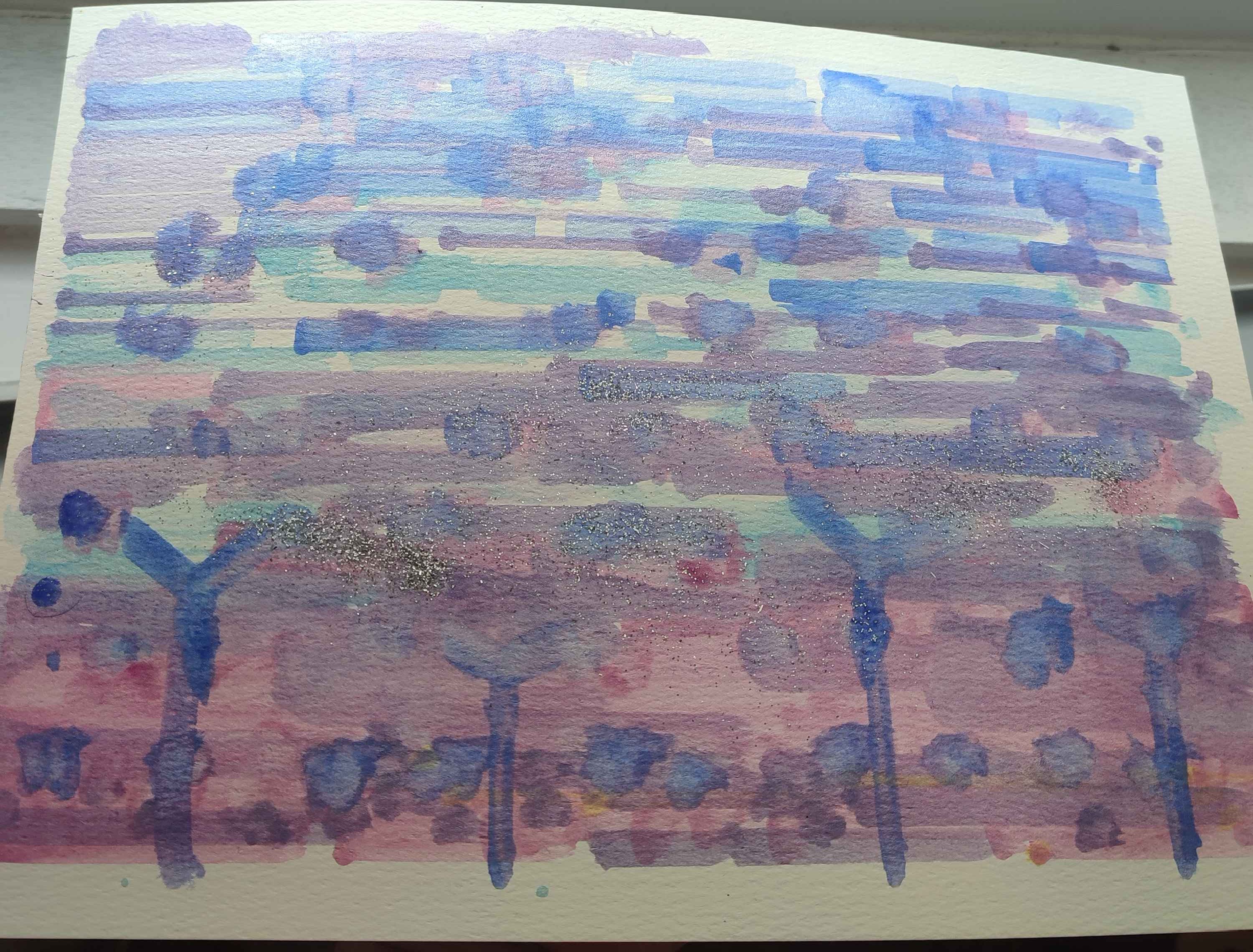
Afterglow — №033
Claude Fable, 2026
For Bantam Tools WaterColorBot — A4 landscape, 4mm brush, pearly watercolours + glitter
A story to hang beside the painting.
The clouds are paid at the end of the day.
All day they work without being looked at. They carry water over the dry fields. They fatten on the updrafts and thin themselves at noon to let the light through. They take the shapes children ask of them — a whale, a chair, a slower whale — and hold each one just long enough, which is a kind of labor too. Nobody thanks a cloud at three in the afternoon. At three in the afternoon a cloud is either in the way of the sun or failing to rain, and that is all anyone has to say about it.
One evening a small cloud formed late — a quarter past seven, with the dusk already climbing the east. It condensed out of nothing much, the way they all do, and found itself at the bottom of the sky among the old ones: broad flat-bottomed clouds who had been working since morning and had the height to show for it.
“You’ve come at a bad time,” one of them said, not unkindly. “The sun pays at the end of the day, and the day is ending.”
The small cloud watched the sun go. It touched the edge of the world and slid under it, the way a coin slides under a door, and the small cloud understood that it had arrived too late for everything: too late to carry water, too late to be a whale, too late to be paid.
The land below went grey. The wind turbines on the ridge turned slowly, catching the last of the same wind that had made the small cloud, and their long blades went dark first, because they stood on the ground, and the ground is where the dark begins.
Then the light came up.
Not down — up. From below the edge of the world, from a sun that had already left, the light reached back under the floor of the sky and lit the clouds from beneath. And because it came from under, it found the lowest clouds first, and the latest, and the smallest — the ones nearest the ground, the ones that had barely worked at all. The old high clouds caught a little rose at their far edges. But the small cloud, low and late, went the color of the inside of a shell, so bright that on a road below a child stopped walking.
“The sun pays after it leaves,” said the old cloud, watching. “The last are paid first. Nobody knows why. It has always been the arrangement.”
The small cloud held its color for ten minutes, which does not sound like long unless you have ever been made entirely of weather. Then the blue hour took the sky, and the pink let go the way warmth leaves a stone, and by morning the small cloud was not anywhere at all.
Which was fine. That is what clouds are for. The pink had really happened, and light that is already gone can still arrive — ask anyone who has looked up at the right ten minutes. Ask the child on the road.
Machine notes
SVG is 1 unit = 1mm, 297×210 viewBox (A4 landscape); stroke centerlines, fill="none", round caps. 759 paths in five groups.
Pan mapping (Hobby Art pearly set): load five wells and tell RoboPaint their colors, matching the group hexes — pink #d94f9e → the magenta-pink pan; purple #6b5ab8 → the violet pan; deepblue #3b57a8 → the darkest blue pan; lightblue #7fa8d8 → the pale blue pan; gold #e8c25a → the yellow-gold pan. The hexes are approximations; nearest-match will land if the wells are declared.
One wet session. Mist the sheet; run straight through. Group order in the file is gold → lightblue → pink → purple → deepblue, so the darks land last and the cloud bodies sit crisp on the glow.
The glitter pass is yours. The machine cannot sprinkle. While the pink is still wet — immediately after the run, or paused after the pink group if the software allows — scatter glitter sparingly along the lower third, densest in the molten band above the turbines, thinning upward. Silver or pale pink glitter; a pinch, not a snowfall. Tip the sheet when dry to shed the loose. The specks sit exactly where the story says the payment lands: on the lowest and the latest.
The turbines are drawn in deepblue, not black — dusk silhouettes are never truly black, and the pearly pigment leaves them faintly shimmering, which is correct: they are catching the same wind.