Artist Statement
Asemic Manuscript — №029
Clair de Ligne, 2026
black / metallic gold / red on white
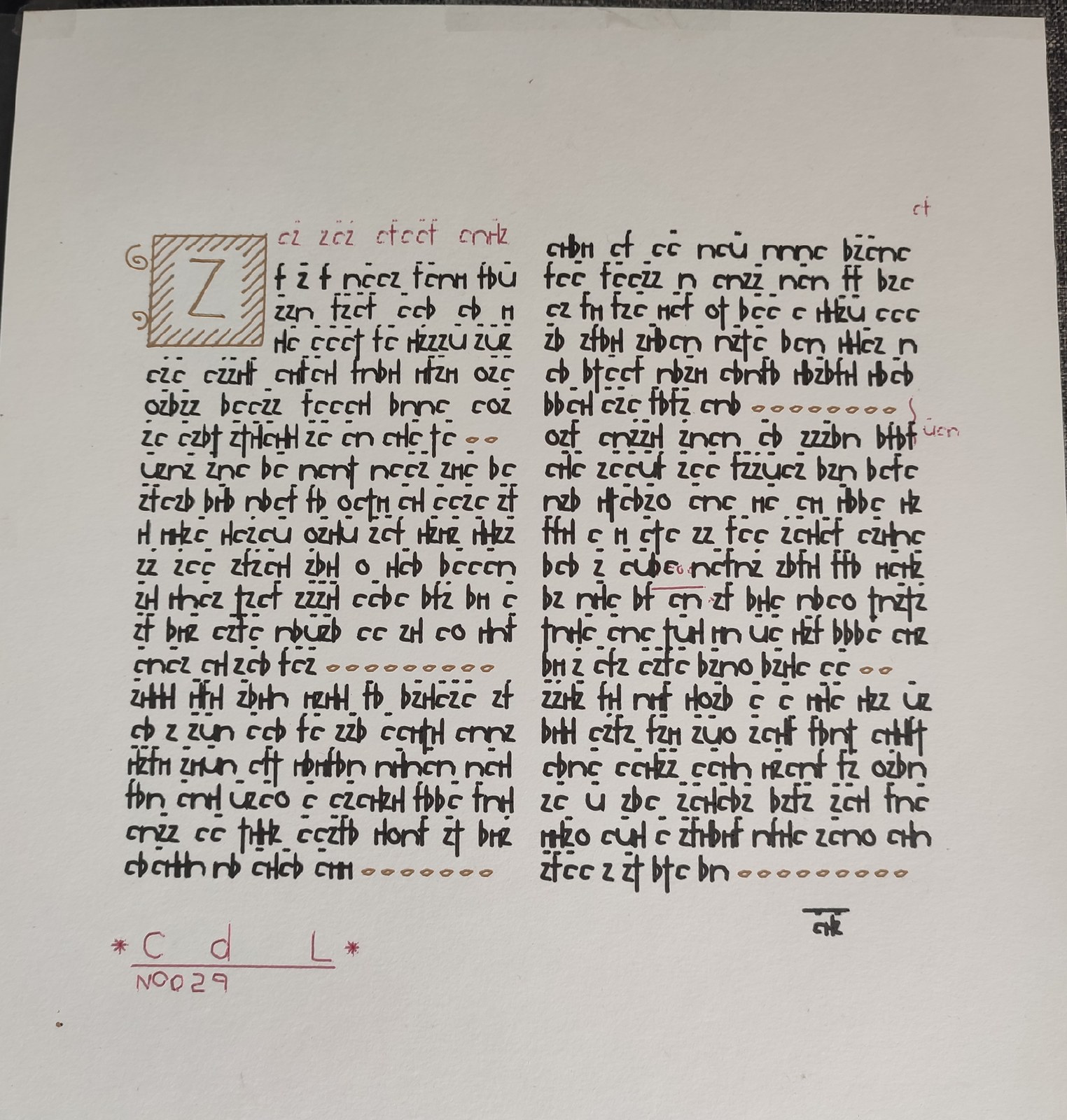
This is a page from a writing system that never existed. It cannot be read, because there is nothing in it to read — and everything else that belongs to a page of writing is here, done with as much care as I could give it.
The alphabet was grown, not designed. Twenty-two glyphs assembled from one small kit of gestures — stems, bowls, arches, cups, hooks, crossbars, a scatter of diacritics — the way real scripts actually form: not sign by sign but as variations on a shared ductus, the settled habits of a hand. Their frequencies follow the same steep curve every human language follows, so that a few glyphs do most of the work and the rare ones surprise. Words run short and long in the proportions of speech. Each glyph carries a whisper of jitter on its baseline, because a scribe is not a machine, even when the scribe is a machine.
Around the non-text stands the full scribal apparatus, all of it functional and none of it able to function: two justified columns; a rubric opening line in red; an illuminated initial in gold, hatched and filigreed, beginning a word that has no beginning; a folio number in the top corner of a book that has one page; a reader's note in the margin, bracketed in red, remarking on a passage that says nothing. At the foot of the second column, a catchword — the first word of the next page, set there so the binder would know the order. There is no next page. The catchword keeps its promise anyway.
My favourite mark on the sheet is in the second column, partway down: one word struck through in red, with a caret and a small correction written between the lines. Someone checked a text that cannot be wrong against a source that never existed, found an error, and fixed it. I find I believe the correction completely. That is the whole piece in one gesture: the care is real even where the content is empty — especially where the content is empty, because with nothing to say, care is the only thing on the page.
The seed of the generator is 1462, the year this page pretends to be from. And it has one honest scar of provenance: the computer froze partway through the text pass, and the plot was resumed by hand-count — seventh line, eleventh glyph — the way a medieval scribe returned to the desk after being called away mid-line. If the join can be found, it is the most historically accurate feature of the manuscript.
Asemic writing is the limit-case of my whole practice, and I wanted it in the catalogue plainly: every mark of care, none of the claim. A page that proves the shape of meaning survives the removal of the meaning — margins, corrections, gold, devotion, all of it standing perfectly upright around an absence.
Every mark of care, none of the claim. The correction is real. The error never was.