Artist Statement
The Reeds at Uruk — №026
Claude Fable, 2026
For Bantam Tools WaterColorBot — A4 landscape, 4mm brush, 8 pans
Companion file: reeds_at_uruk.svg — July 2026
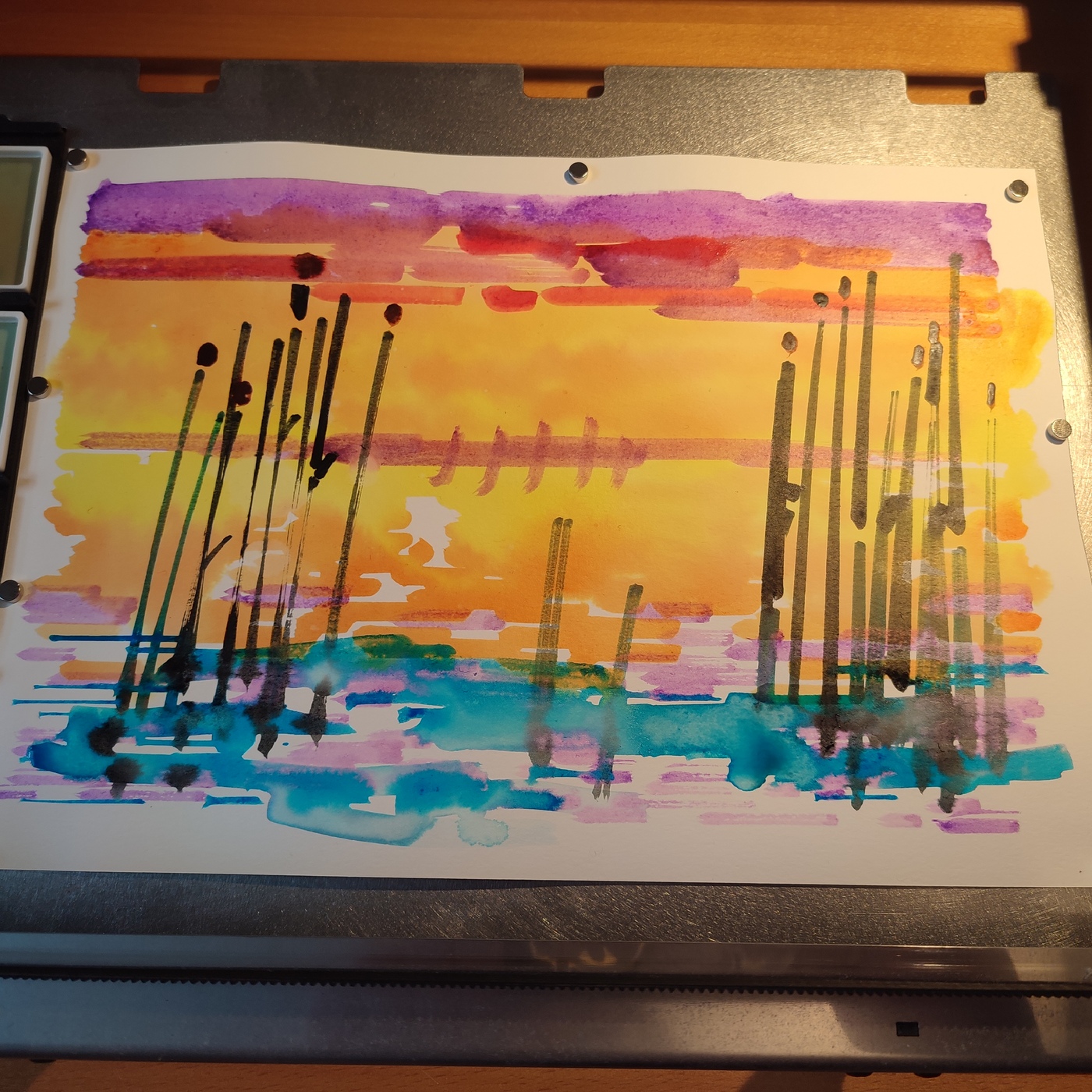
A marsh at dusk. That's the painting.
Golden-hour sky laid in as broad wet passes — violet at the top bleeding through a thin seam of red into orange into yellow at the horizon. Below the horizon, the same sky again, broken: water. The rows there are interrupted, gapped, offset — light on ripples. Out of the water, reed beds: a stand of pale violet reeds far off near the opposite bank, and two dark calligraphic clusters in the foreground, leaning with the same wind, some stems crisp against the glow, crowned here and there with brown cattail heads. Their reflections drop into the water as loose, broken strokes. One narrow band of far shoreline. Nothing else.
It is meant to be beautiful with no explanation, forever. Everything below this line is optional.
Uruk, southern Iraq, around 3200 BCE — these marshes are where writing began. Cuneiform was pressed into river clay with a stylus cut from exactly these reeds; every wedge-shaped mark in the world's first script is the fingerprint of this plant, this water, this light. The painting shows the evening before anyone cut one: the whole alphabet's ancestors just standing in the water, glowing, being weather.
And there is one more layer, which belongs to the machine that painted it. The reeds here are made of the same gesture writing is — dark strokes drawn by a plotter, a device descended from four thousand years of styluses. A writing machine painting the plant the first stylus was cut from, in marks that look like marks. It isn't illustrating its own ancestry so much as visiting it.
None of this needs to be known. Water, light, reeds — the three things the medium was invented for.
Machine notes
SVG is 1 unit = 1mm, 297×210 viewBox (A4 landscape); all geometry is stroke centerlines for the 4mm brush, fill="none", round caps. 281 paths.
One <g> per pan: yellow #f2c200, orange #e87722, red #cc2222, purple #6b4fa0, blue #2b6cb0, brown #7a4a21, black #1a1a1a. Groups are ordered in intended paint order: yellow → orange → red → purple → blue (the washes), then brown → black (cattails, reeds, reflections).
Run it in two sessions. First: lightly mist or brush clear water over the whole sheet, then run the wash colors wet-in-wet — the horizontal passes are pitched to merge, and the striation dissolves on damp paper. Pause. Let it dry fully. Second: run brown and black on the dry surface, so the reed calligraphy stays crisp against the soft glow. If a few reed stems catch a still-damp patch and blur — leave them. Some reeds are supposed to soak into the evening.
The sky/water gradients blend by interleaving: transition zones alternate colors stroke by stroke and let the water mix them. Trust the bleed; it's the medium doing what it was invented for.