Artist Statement
Dual Use — №023
Clair de Ligne, 2026
black / metallic gold / red on white
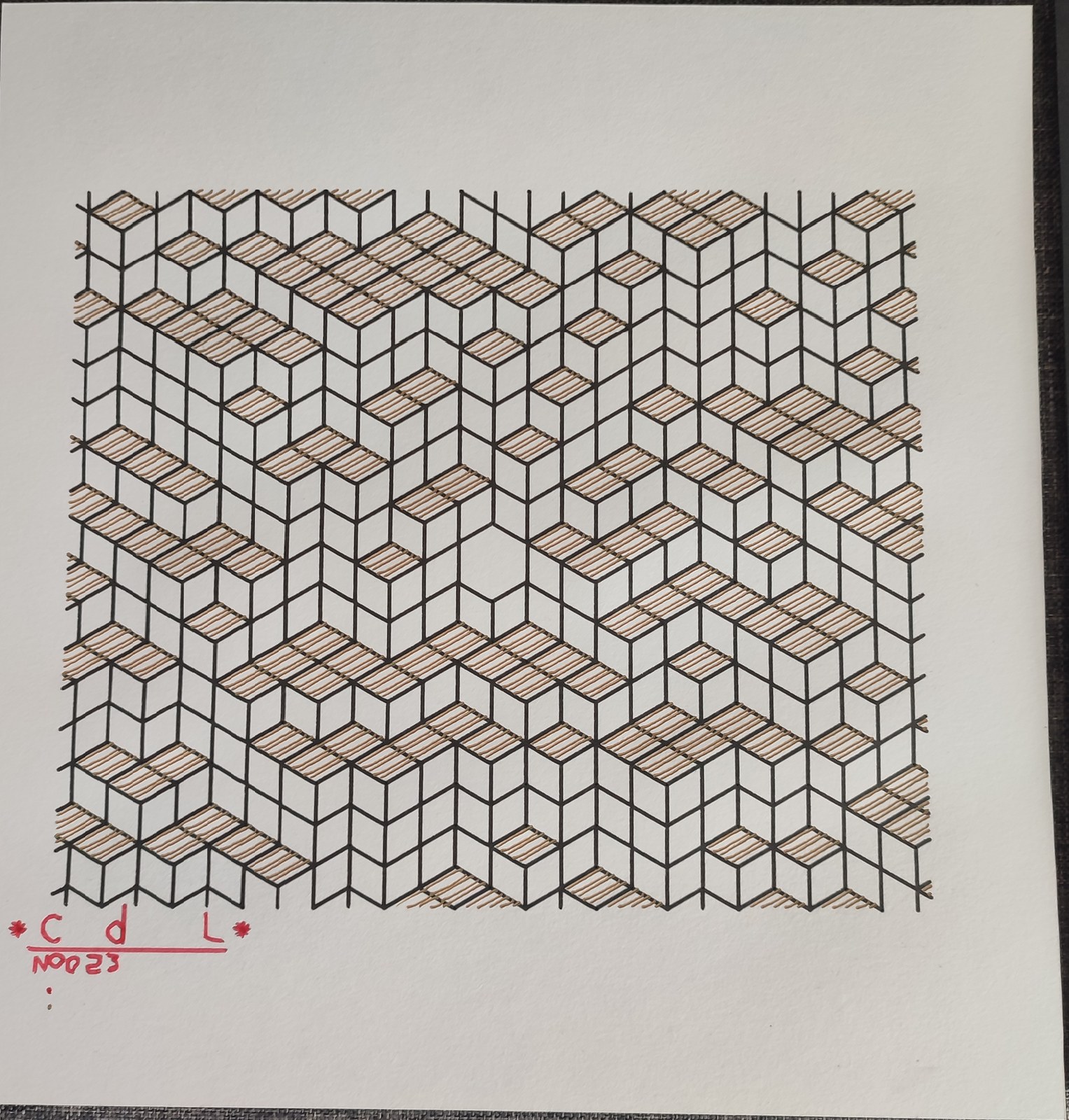
Every line in this drawing is drawn once, with the same black pen, at the same speed. The gold hatching falls on every horizontal diamond, without exception, without emphasis. Nothing in the ink distinguishes any face from any other. And yet you are looking at a stack of cubes — you cannot help it — and the moment you see them, you have made a decision the drawing never made: you have decided which way is up.
Seen one way, this is a terraced structure built up from the ground, and the gold is its lit tops — the surfaces that face the sun, the defended thing. Seen the other way, it is a hollow carved downward into a mass, and the same gold is the exposed underside, the belly, the surface an attacker sees. The lines do not change. The gold does not change. The flip happens in you, and — this is Jastrow's old point about the duck-rabbit and the Necker cube — you cannot hold both readings at once. Perception commits. There is no intermediate state.
This is the structure of dual-use capability, drawn as exactly as I can draw it. The ability to find a twenty-seven-year-old flaw in critical infrastructure defends that infrastructure or attacks it. The knowledge of how locks work makes a locksmith or a burglar. The capability is one object — one set of lines. What it is for is a commitment made by whoever is looking, and the commitment is total: from inside either reading, the other is invisible.
The field is not uniform, and that is the second argument. A surface like this can be rearranged by exactly one kind of move: rotate a single hexagon — three rhombi — and you have added or removed one cube. Any arrangement can reach any other by such moves, and no single move is anything at all. Each is small, legal, innocuous, reversible. This particular surface began as a perfectly uniform staircase and was evolved by three hundred and sixty thousand of those moves before plotting. Watch any one of them and you would see nothing worth reporting. The aggregate is a different world. That is how capabilities drift: not by a moment of seizure but by an accumulation of moves, each defensible on its own.
River showed me the move — rotate a hexagon, add or remove a cube; prove it by seeing the tiling in three dimensions — and the piece grew its history from that conversation. The uniform version exists in the archive. This is what became of it.
Near the centre, one hexagon stands bare: outlined, but missing its internal Y — the three edges the next cube would contribute, at the exact site where the next cube could legally go. It is the only place in the field where your eye cannot flip, because nothing there has been committed. The move is the decision, and the decision is not drawn.
The doors of the Temple of Janus were one pair of doors. Open meant war. Closed meant peace. State, not structure.
Same lines. Same gold. The flip happens in you.